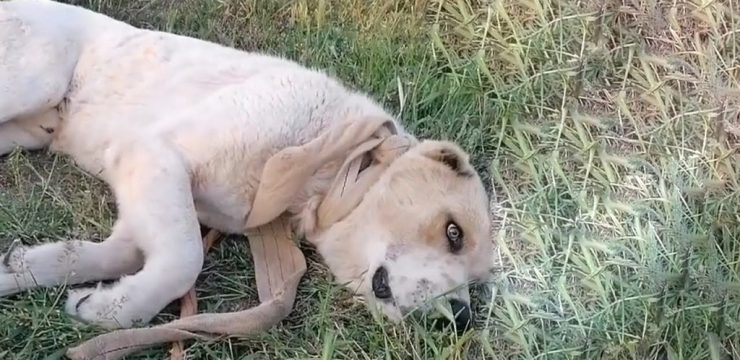
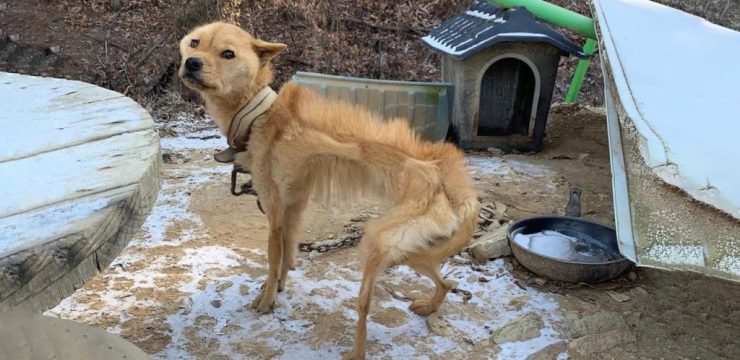
In the soft hush of an early morning, before most people had even opened their eyes, a roadside worker noticed something small and motionless lying near the edge of the pavement. As he stepped closer, he realized it was an older cocker spaniel, curled tightly into herself as if she had been waiting there for hours—maybe even through the cold night. Her frail body trembled slightly, and her cloudy eyes revealed not just age, but a long history of quiet suffering. That little dog had a name, though no one nearby knew it yet. Her name was Iveta.
Iveta had once belonged to someone. She had once lived indoors, but her life had not been one of comfort or affection. Instead, she had been used repeatedly for breeding, her puppies sold off while she remained behind, worn down by the physical toll. And when she became too old to produce more litters, she was simply discarded—left alone to fend for herself as if she had never mattered at all.

When rescuers brought her in, their concerns stretched far beyond her visible symptoms. Yes, her left eye was completely blind. Yes, her ears were painfully infected, swollen from years of neglect. Yes, her coat was matted, her face weighed down with fatigue, her posture stiff and defeated. But what troubled them most was what they couldn’t see on the surface—the hidden injuries that come from years of being overlooked, uncared for, and forgotten.
A medical team immediately examined her. As they worked, the reality of her condition became heartbreakingly clear. Iveta had a tumor on her spleen, a serious condition even for a healthy dog. For a senior dog who had endured so much, it was a dangerous complication. Her heart, weakened by age and stress, struggled under the simplest tasks. Some days, she needed an oxygen mask just to breathe properly. The veterinarians worried not only about her physical challenges but also her ability to survive without significant, long-term care.
Yet, despite everything she had endured, Iveta remained astonishingly gentle. She never barked, never pulled away, never showed fear or aggression. Even when her infected ears were cleaned or her blind eye examined—procedures that would make many healthy dogs flinch—Iveta remained still, accepting each touch with a quiet, weary patience. Her rescuers quickly realized that this little dog, who had been given so little kindness in her life, still had an open heart. She trusted them, even though the world had given her every reason not to.
The veterinary team, moved by her courage and softness, did everything they could for her. Thankfully, while the tumor was serious, it could be managed with medication and careful monitoring. Surgery would be too risky for her fragile heart, but she wouldn’t need it immediately. That small piece of good news brought relief to everyone who had grown attached to her in such a short time.
Just when things seemed to be settling into a manageable plan, something unexpected—and deeply unsettling—occurred. The person who had abandoned Iveta returned, demanding that she be handed back. They threatened to report the rescuers for keeping the dog without permission. But this time, the rescuers stood firm. They had clear evidence of long-term neglect, and they refused to return Iveta to a situation that had already caused her so much harm. It became a tense situation, but the team made one thing completely non-negotiable: Iveta’s safety.
After careful evaluation, the decision was made that Iveta would need daily medication for the rest of her life. She would need a calm, stable environment—no running, no stress, no overwhelming activity. Just peace, gentle walks, and regular medical checkups. Her recovery would be slow. She would carry the burden of her past for the rest of her life. But for the first time, she had something she had never truly known before—a real chance.
When Iveta was finally discharged from the clinic, she walked beside her rescuer with a delicate wag of her tail. She stayed close, almost glued to their side, as if she understood that she was finally safe. There was no pulling, no hesitation. She simply followed with quiet certainty. And in that simple act of trust, she spoke louder than words ever could. She wasn’t just following a person—she was following hope.
As the day came to an end, Iveta curled up in the back seat of the car. Her breathing softened, her body slackened, and her eyes gently drifted closed. For the first time in years, she could rest—truly rest—without fear. She was exhausted, worn down by countless hardships. But she was not defeated. She was heading toward a different kind of life, one where she would never again be used, forgotten, or abandoned.
Iveta’s story is undeniably sad, but it also carries an unmistakable message of grace and resilience. It reminds us that even those who have suffered the deepest wounds can still find comfort and trust again. It teaches us that kindness has the power to heal in ways medicine alone cannot. Her journey stands as a quiet yet powerful call to protect those who cannot speak for themselves—to step forward when we see suffering, and to believe that every life, no matter how small or fragile, deserves care.
Iveta may represent countless dogs abandoned when they become “inconvenient,” but she is also a symbol of hope—a reminder that some are fortunate enough to be found in time, to be saved, and to finally experience the gentle love they always deserved. And for Iveta, that love made all the difference.