Along the edge of a busy roadway, a fragile figure lay unnoticed, nearly swallowed by the constant movement of life passing her by. She was a Great Dane named Odji, though none of us knew her name then. All we saw was a once-noble dog reduced to a shadow of herself—bones sharp beneath thinning skin, eyes dulled by exhaustion, and a body so weak she could barely lift her head. People walked past, cars hurried on, and the world kept moving while she struggled simply to survive.
Most glanced at her with discomfort, as if acknowledging her suffering demanded more than they were willing to give. Some waved her away, treating her like a small inconvenience instead of a living soul in desperate need. But one person finally stopped. A compassionate stranger knelt beside her, offering the first act of kindness she had likely received in a very long time. That simple moment—one human choosing not to look away—became the spark that saved her life.
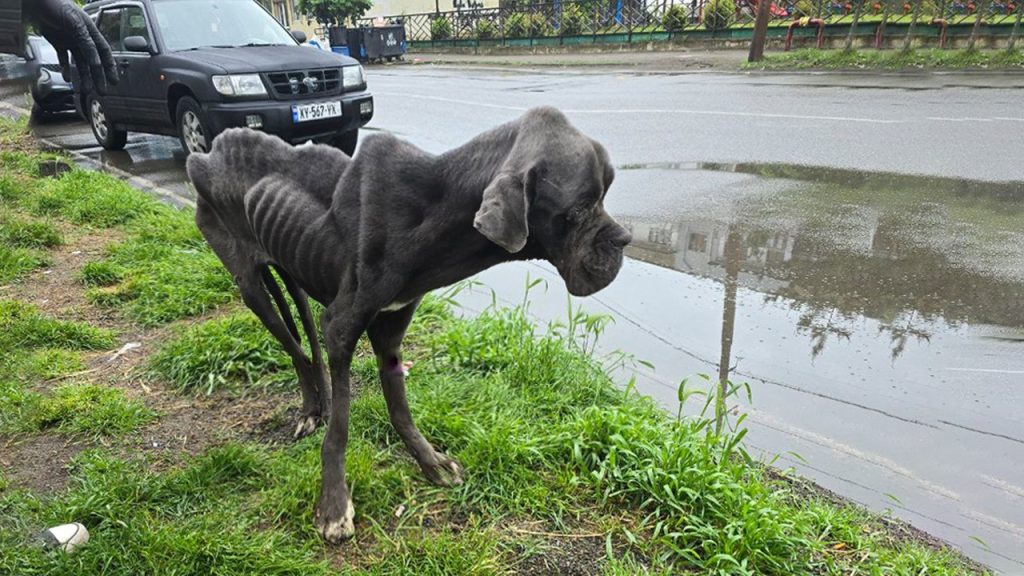
Odji was rushed to a veterinary clinic, her fragile body resting heavily in the arms of her rescuer. The vet’s expression turned grave as the examination revealed the truth: she was severely malnourished, suffering from extreme neglect, and overwhelmed by a serious tick infestation. Her organs were failing, her muscles had nearly disappeared, and her body temperature was dangerously low. The staff whispered the devastating number—she had only a one-percent chance of survival. Then, without warning, her body trembled in a violent seizure, leaving everyone around her terrified that she might slip away.
But somewhere inside that weakened frame, a tiny spark held on. Odji survived the night, refusing to let go despite the pain and the odds stacked against her. The days that followed demanded constant, gentle care. IV fluids dripped steadily into her fragile body, warming blankets surrounded her, and soft voices encouraged her to stay. She barely moved at first, lying still for long stretches of time as though unsure whether her body was capable of healing. Yet slowly, almost imperceptibly at first, change appeared.

Her once-dull eyes began to focus again. Her ears twitched at familiar voices. And then came the moment everyone had been waiting for—her first attempt to stand. Her legs trembled beneath her, unsteady and frail, and she collapsed more than once. But each time, she tried again. Gentle meals helped rebuild her strength, softening her sharp ribs and adding warmth back into her frame. Her coat gradually regained its shine, and with it came something even more precious: a renewed spark of spirit.
In one especially touching moment, her rescuer softly called her name. “Odji.” She lifted her head, responding for the very first time. That small gesture brought tears to those who had stood by her side, watching her climb inch by inch back into life. Soon she began learning basic commands, offering shy tail wags whenever she succeeded. Toys were introduced, though at first she didn’t seem to understand what they were. But instinct awoke within her, and the day she chased a ball for the first time, her joy radiated through the room.
Her world expanded even more the day she visited the beach. Soft sand shifted beneath her paws, and cool waves rolled quietly nearby. Odji didn’t merely walk—she ran, stretching her legs with a freedom she had nearly forgotten existed. She chased balls across the shoreline, leapt with playful abandon, and rolled happily in the sand as though discovering joy for the very first time. Watching her run, strong and confident, felt like witnessing a miracle in motion.
Today, Odji is almost unrecognizable compared to the frail dog found on the roadside. Her body is strong, her coat shines under the sun, and her eyes reflect curiosity and trust. She now lives in a forever home where love, comfort, and safety surround her daily. But perhaps the most remarkable part of her story isn’t just her physical recovery—it’s the lesson she brings to all of us. For many older adults who have watched the world shift and change, her journey touches something deep and familiar.
It reminds us of a time when neighbors looked out for one another, when kindness was expected, not exceptional. Odji’s story rekindles the belief that compassion still matters, even in a world that sometimes feels hurried and distant. She shows us that every life—no matter how worn, how fragile, or how overlooked—is worthy of being seen and supported. And she proves that healing rarely happens through grand gestures; it grows through steady care, patient hands, and the willingness to stay present.
Odji’s transformation is a testament to what can unfold when we choose not to turn away from suffering. Her survival was not the result of luck alone but of one person’s decision to stop, to kneel down, and to believe her life still held value. In a world that often rushes past the vulnerable, her story calls us to slow down and pay attention. It reminds us that hope can take root in the smallest acts of kindness, and that sometimes those acts bloom into miracles we never expected.
May her journey serve as a reminder that every life holds potential, even when it appears dim. The next time we encounter someone—or some creature—in need, may we choose to pause, extend a hand, and believe in the possibility of renewal. For it is often the simplest, heartfelt gestures that carry the power to change lives.